
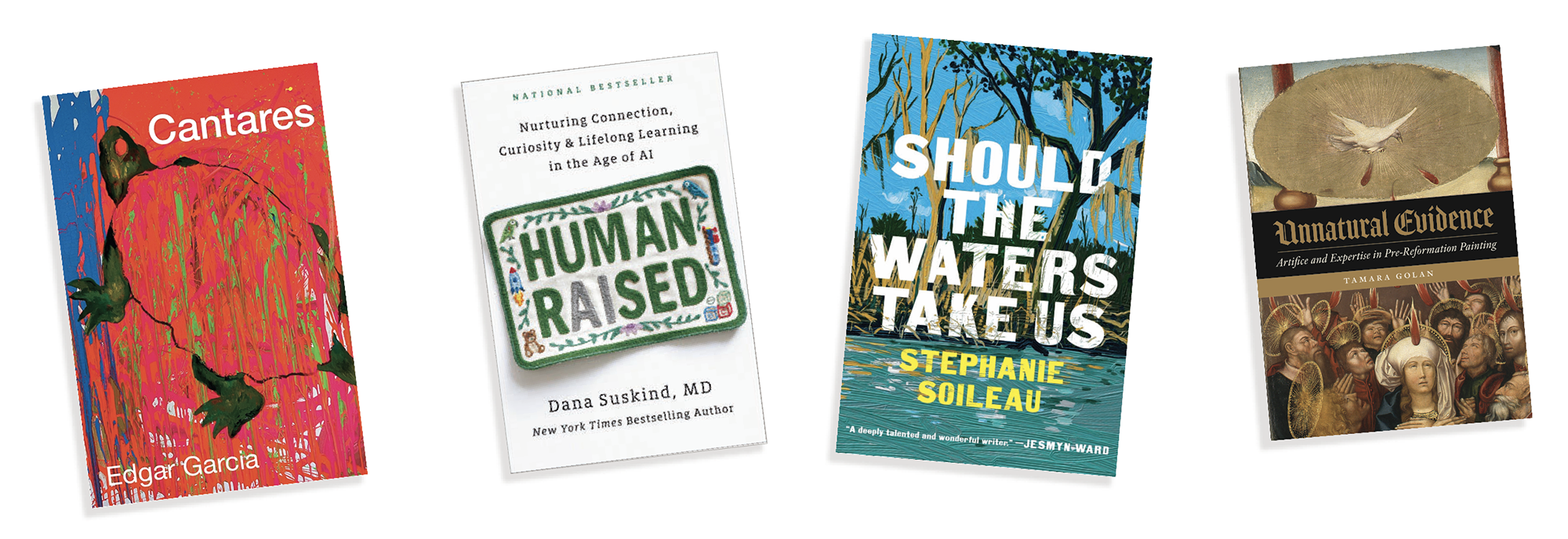
A selection of recent books by UChicago faculty members.
Cantares
By Edgar Garcia, Professor in the Department of English Language and Literature
In essay and verse, Edgar Garcia reimagines the Cantares mexicanos, a 16th-century collection of 91 songs in Nahuatl, an Indigenous language spoken in parts of Mexico. Adapting this work today, Garcia draws on themes of loss and lineage from the original songs, while examining the Cantares within the broader context of colonization, linguistic upheaval, and artistic production. The original Cantares reflect European sensibilities as well as the collective memory of a precolonial era, writes Garcia: “They were put to paper mid-16th century, by which time many were remembering a time before the Spaniards or recollecting what they had been told by elders.” As he meditates on this product of intense cultural rupture, Garcia affirms art’s transcendent power.
Human Raised: Nurturing Connection, Curiosity, and Lifelong Learning in the Age of AI
By Dana Suskind, Professor of Surgery
Artificial intelligence–powered tools offer tempting solutions to the stresses of raising children. They might promise to lift parenting burdens by planning meals and writing shopping lists, or to support young bodies and minds by tracking sleep patterns or offering personalized tutoring. Humanlike as these tools may seem, Dana Suskind cautions, they differ from us in a crucial way: They do not care about children. While some of them could be beneficial, replacing valuable human connection with an approximation of it could pose risks to children. Drawing on research in early childhood development as well as in behavioral economics and other fields, Suskind seeks to help parents and caregivers understand the importance of human interaction for young children, the risks different kinds of AI pose to this development, and the subtle pressures to adopt new technologies. Suskind offers a clear framework to help adults critically assess new AI-powered tools before incorporating them into a child’s life.
Should the Waters Take Us
By Stephanie Soileau, AB’98, Assistant Professor of Practice in the Arts in the Department of English Language and Literature
Wilford “Boy” Broussard lives simply and contentedly off his uncle’s land on the southern Louisiana coast, surviving by fishing and hunting. But things get complicated when he becomes responsible for a 12-year-old daughter he barely knows. As Boy and his daughter navigate this new relationship, larger fault lines are exposed: between Boy and his extended family, the local Nigerian priest and his parishioners, the community and oil company executives. Two catastrophic events—an explosion on an offshore oil rig and a major hurricane—threaten to upend the already precarious conditions. Shifting between the past and present, between France, Acadia, and southern Louisiana, Stephanie Soileau places these events in the 400-year history of Louisiana and Cajun culture. She shows how a way of life came to be and reckons with the environmental, cultural, and political forces that threaten it today.
Unnatural Evidence: Artifice and Expertise in Pre-Reformation Painting
By Tamara Golan, Assistant Professor in the Department of Art History and the College
In 1507 a scandal at a Dominican church in Bern, Switzerland, raised questions about the intersections between law, religion, and art. A statue of the Virgin Mary appeared to cry tears of blood, but this supposed miracle was roundly debunked. The “divine” tears, artisans asserted, were painted on—and not even particularly well. The friars behind this and other tricks were tried and put to death for their falsified miracles. Their story is part of a larger one of increasing skepticism about depictions of the divine, and Tamara Golan interrogates how this context impacted art. She observes how three generations of Swiss artists developed an intentionally unnatural style in the decades before the Reformation, using techniques like distorted perspective to distance themselves from claims of deception and to emphasize their artistry. Through this “alternative naturalism,” Golan argues, these artists opened new possibilities for representing both the natural and supernatural