
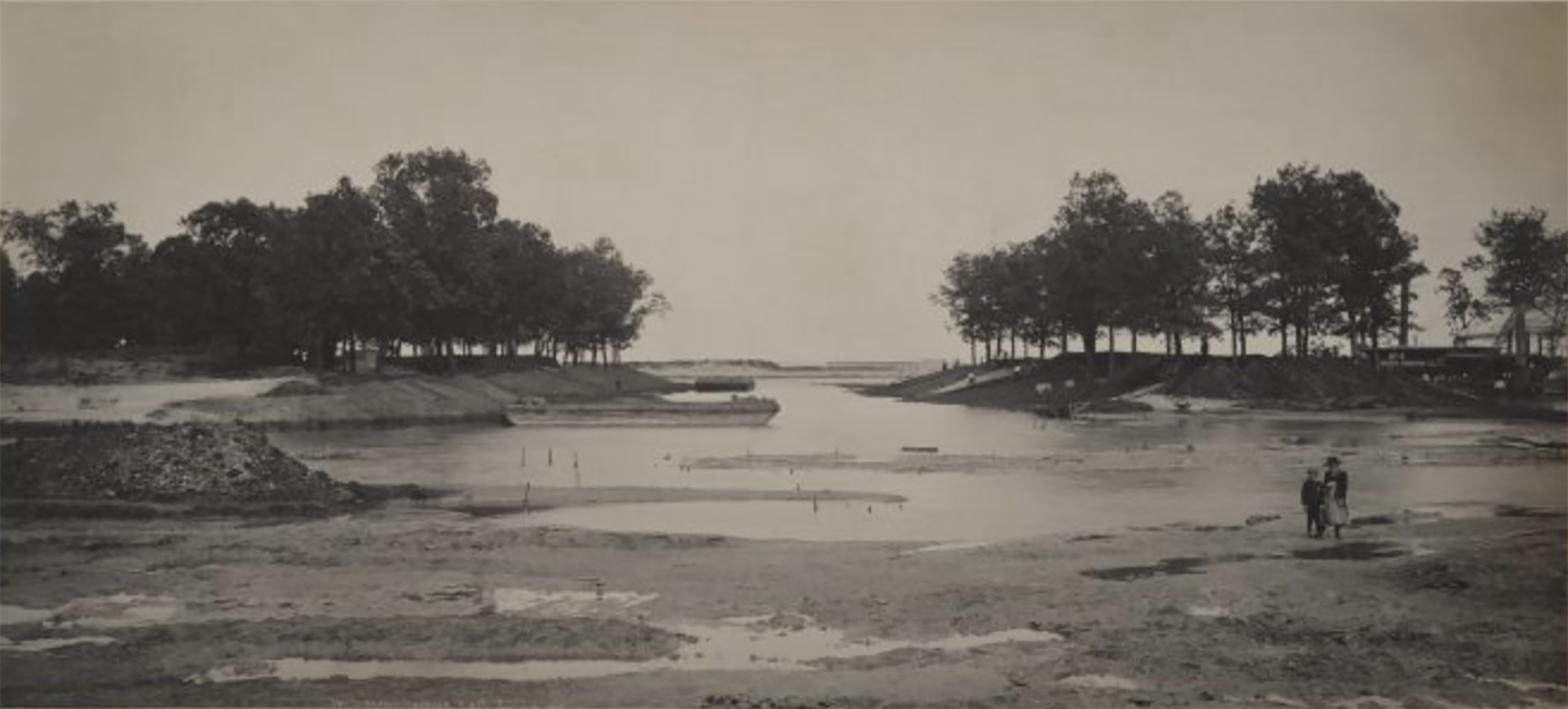
An 1892 photograph showing beach ridges in the area that would become Jackson Park’s Wooded Island. (Photography by Charles Dudley Arnold/Chicago Public Library Special Collections & Preservation Division)
Join a private tour of Jackson Park’s spring wildflowers with biologist Michael LaBarbera.
When Michael LaBarbera offered to give the Magazine a tour of the spring ephemerals popping up in Jackson Park’s Bobolink Woods in early April, we leapt at the chance. Ephemerals are flowers that emerge in woodlands in early spring, before the trees leaf out. Almost as quickly as they appear, they are gone—only to appear again next spring.
LaBarbera, professor emeritus of organismal biology and anatomy, visits Bobolink Woods—just south of the Museum of Science and Industry—several times a week, from spring to autumn. He has created a website, Southside Flowerpedia, to help other visitors to Jackson Park identify the flowering plants they see there. It includes photos and descriptions of 550 species. By LaBarbera’s count, 73 percent of the species are native.
This interview has been edited and adapted.
What is the natural history of Jackson Park? Why does it have so many native plants?
Jackson Park is much changed over the last 150 years. The street we just passed is called Lake Park because it once led to the Lake Park, which today we call Jackson Park. It was much smaller then, and Wooded Island [in the middle of Jackson Park lagoon] didn’t exist.
The configuration of Jackson Park is an accident of the last glaciation. The glaciers were retreating. As Lake Michigan dropped lower and lower, it would leave behind these beach ridges of sand. If you’ve ever noticed, the Metra tracks are on a big hill.
I thought that was fake.
It’s not fake. It’s the old beach ridge. They picked that route to get the train line up off the ground.
In the late 1800s Chicago got the rights to do the World’s Columbian Exposition of 1893, so they needed to create the grounds. Wooded Island was originally beach ridges with swales—low areas—in between. They dug out the low areas to make lagoons. I have a photo taken in 1892 from Wooded Island, and it’s a mess. [See top image.]
Some of the land plants have been here for 150, 200 years. The grounds and the water date from the Colombian Exposition. So I find that figure of 73 percent [of native species] astonishing. Everything has been disturbed and re-disturbed, over and over again.
The soccer fields to the south were originally part of the lagoon. In the 1950s the US Defense Department decided they needed to protect the major cities of the US from the Soviet Union, so they installed a Nike missile base under Bobolink Meadow. They filled in the lagoon to allow passage south.
Bobolink Meadow is very much a constructed site. It’s one of those interesting examples of humans modifying things, and nature putting up with whatever humans throw at it. So it’s hard to tell what plant is native, and what plant is introduced, just by walking around.
How can you tell?
I strongly recommend this app called Seek. I love knowing the names of things. It used to be you had to have a field guide. You would flip the pages, and go, “I don’t know if it’s that or that.” An app is just marvelous.
During the summer Bobolink Woods is a very dense wood. What you’re seeing here now are spring ephemerals. Two weeks ago, there was nothing.

These are Virginia bluebells. The bluebells will last for, oh, a month, month and a half, and the leaves will persist. Now that you recognize it, you’ll see it everywhere.

And this is Dutchman’s-britches, or -breeches, depending on which form you like.
Is that a ramp?

I’m not sure what that is. That’s why you want Seek. [LaBarbera takes a photo on his phone and consults the app.] Wild leek or ramp, allium tricoccum. Good guess. [He snaps a photo of the same plant with a digital camera.] I take pictures of the flowers and take a picture of the ID. Then I switch to my GPS app and take a picture of the site. So I have GPS coordinates on every plant I’ve identified.
So this guy, I am pretty sure, is sharp-lobed hepatica.

Yes, score! This is a native plant. These will last about 10 days, and that is it for the year.
This little guy is called bloodroot. It’s distinctive because of the bright white flowers.

So pretty.
If you break the stem or the root, bright red sap leaks out. You don’t want to get it on you, because the sap contains a mitochondrial poison.
People used to use this when they had a wart. They would break the root and touch it to the wart for 10 minutes, all the cells would die, and the wart would be gone. Of course, if you left it for 15 minutes, you ended up with a hole in your hand.
These sprouts that are just coming up—this is wild ginger.

If you come here in another three to four weeks, it will be covered with violet leaves. And if you push the leaves apart, you’ll see, right at ground level, a brown flower. Obviously designed to be pollinated by flies or beetles, although apparently it no longer is pollinated by anything. It reproduces asexually.
Here’s some more bloodroot. Really lovely, such a lovely plant. It’s just like, “Look at me! Pollinators, I am here!”
So how did these plants get here? Did humans plant them, or they just got themselves here?
They’ve all gotten themselves here. As near as I can tell, from aerial photos from the 1940s and 1950s, this patch of woods was here well before World War II. It may be one of the oldest patches of woods around here. I think that’s why you see so many natives.
Later on, there will be something called yellow bellwort, with bright yellow drooping blooms and big leaves.

There will also be large-flowered trillium.


And there’s a second trillium, prairie trillium. It’s got a maroon blossom that sits on top of three leaves and looks like a pyramid. So check back in about three weeks. It will be right along the path.

The other thing we get in here is Jack-in-the-pulpit. It’s too early.

So will the Park District come through and yank that patch of scilla, since it’s invasive?
The Park District doesn’t care. I’m of two minds on what to do with invasives. I really am of two minds.
On the one hand, I’m willing to treat exotics that are very aggressive, and crowd out what had previously been a thriving ecosystem, as plantae non gratae. If the scilla had been impinging on a patch of trillium or spring beauty, I’d rip it out without hesitation.

If it were on a relatively bare patch of the forest floor, I’d tend to leave it alone, as I did.
It’s hard to be a purist on this issue. Humans are invasive in the Americas—albeit, they have been present for 20,000 years. About 30 percent of the plants in Jackson Park are exotics, but some have been here for hundreds of years, like Norway maple. Would I rather they were replaced with bur oaks? Yes, but not so vehemently that I’d want to rip them out by the roots.

This is a phenomenon worth observing. See all these little umbrellas?

This is mayapple. Its roots have some kind of suppressant, so almost nothing grows underneath. The plants keep spreading, maybe by reseeding, but probably asexually. They look like little palm trees, and about halfway down the stem are bright white flowers that turn into fruits in May. By late May, early June, this whole area will be completely impassable—just solid vegetation.
A lot of these plants we’re seeing here are adapted to blooming early in the spring, using stored nutrients. They put leaves up, they bloom, they produce seeds, they disappear.
One of the wonderful things about coming back over and over is where you see one flower, when you come back in a month or six weeks, there’ll be another flower there. And then a third and a fourth as the season goes on. All their roots are intertwined. Except for mayapple, by and large, they get along.