
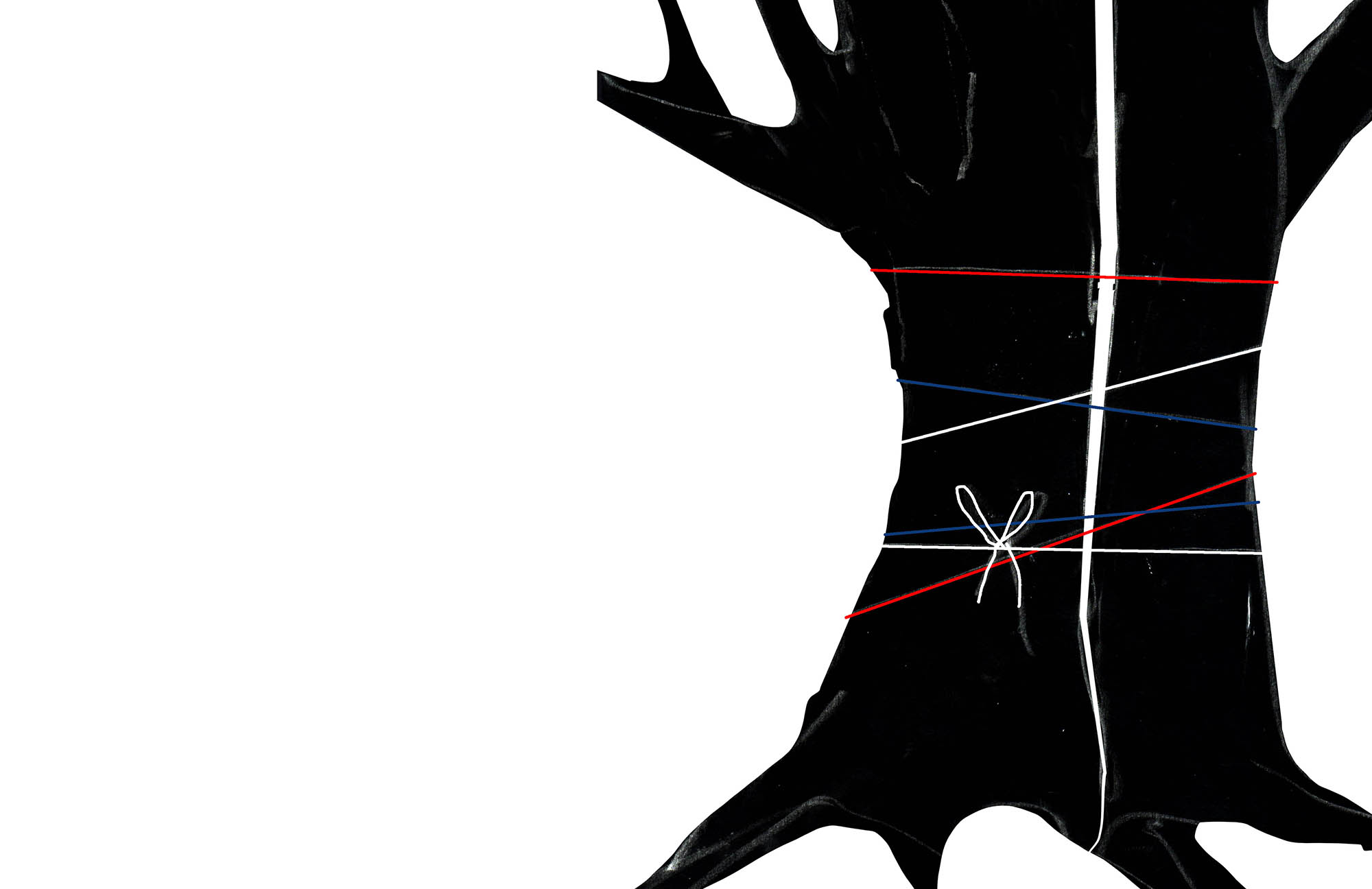
A national security expert reflects on the mounting danger of political violence in the United States.
Political science professor Robert A. Pape, PhD’88, has spent much of his career studying extremism abroad. As director of the University of Chicago Project on Security and Threats, Pape leads a team that documents global trends in suicide attacks, political violence, and militant group propaganda, among other indicators.
Over the past decade he has watched many of the patterns that presaged widespread political violence elsewhere emerge in the United States. In his new book Our Own Worst Enemies: America in the Age of Violent Populism (The New Press, 2026), excerpted here, Pape examines the country’s present moment of precarity and advocates for new democratic safeguards.—S. A.
Helicopters thudded low over a residential neighborhood on Chicago’s South Side—minutes from my office at the University of Chicago. Armored vehicles sealed off a familiar intersection. Federal officers moved in formation, rifles at the ready, as residents watched from porches and sidewalks.
That was not taking place in a failed state. It was taking place in an American city.
What was striking was not the display of force itself. Democracies deploy force. It was how quickly the scene was absorbed into normal life. In an era when Americans watch violence—both at home and abroad—unfold in real time, the greater danger is not that political force goes unnoticed, but that it becomes familiar enough that new thresholds pass without recognition. Conversations resumed. Traffic was rerouted. Phones came out. Within minutes, the extraordinary felt routine.
That quiet normalization—the moment when visible coercion becomes part of ordinary democratic politics—is the problem this book investigates. It marks the threshold at which something fundamental shifts.
Most Americans still assume that political violence is what happens after democracy breaks down. Comparative evidence from post–Cold War democracies suggests the opposite. In stable democracies since the end of the Cold War, significant democratic decline has almost always been preceded by elevated political violence. Institutional erosion does not begin with constitutional rewrites; it begins when coercion becomes thinkable within ordinary political conflict.
Democracy is not undone only by tanks in the streets; it is weakened when citizens and elites alike mentally recalibrate what forms of force are acceptable in pursuit of power.
The United States has entered such an era.
The rise of contemporary political violence in America is rooted in two simultaneous structural transformations.
First, the United States is transitioning toward being a white-minority democracy. For most of its history, the country’s political order rested on the demographic predominance of a single group. That predominance is ending. Demographic transition does not automatically produce instability. But when long-standing majorities anticipate a permanent loss of cultural or political dominance, their perceptions of existential threat intensify.
Second, the United States is experiencing one of the most dramatic concentrations of wealth in its modern history. Economic stratification raises the stakes of political power. It increases the stakes of electoral outcomes and deepens the perception that institutional channels are rigged or unresponsive.
Individually, demographic change and inequality generate strain. Combined, they lead to zero-sum thinking. Elections become less about policy preference and more about group survival. Political defeat is experienced not as a temporary loss but more like dispossession.
These forces are not episodic distortions. They mark the end of the demographic and economic equilibrium that underwrote post–World War II democratic stability. The institutions remain. The underlying social balance has shifted.
Structural transformation does not automatically produce violence. It changes how citizens interpret loss, fairness, and authority. When enough people begin to doubt that ordinary political competition can secure their group’s future, the perceived legitimacy of nonviolent contestation erodes. The danger lies less in polarization than in the decay of legitimacy.

Polarization is visible and noisy. Legitimacy fractures quietly.
In a polarized democracy, citizens disagree intensely but accept the procedural framework. They lose elections yet concede authority. They distrust opponents but do not deny their right to govern.
In a legitimacy crisis, that distinction collapses. Substantial portions of the public begin to see rule by the other side as intolerable rather than merely undesirable. When this threshold is crossed, violence does not appear as rebellion against democracy; it appears as a defense of it.
Free societies rarely abandon democracy consciously; they rationalize departures incrementally.
The implications extend beyond domestic conflict. In earlier eras, external crises often produced national political consolidation in the United States. Major military actions—from the Gulf War to the opening phases of the wars in Afghanistan and Iraq—began with overwhelming public support. Yet early polling during the 2026 conflict with Iran suggests a striking departure from this historical pattern, with public support for the use of force hovering near 40 percent and sharply divided along partisan lines. Whether that division persists remains uncertain. What is already clear, however, is that even the onset of major war no longer automatically produces political unity. Legitimacy fractures shape how citizens interpret not only domestic politics but the use of national power itself.
Over the past decade, the United States has experienced protest waves that turned destructive, rising attacks on public officials, assassination attempts, and the increasing visibility of militarized state responses to domestic unrest. Each episode is debated as an isolated crisis. Each is absorbed into a partisan narrative. What is rarely examined is their cumulative effect. When acts that once triggered universal condemnation begin to divide public opinion, a boundary has shifted.
Political violence does not belong to any ideology; it follows perceptions of power and exclusion. When institutions appear capable of delivering preferred outcomes, coercion tends to be state centered or state adjacent. When institutional avenues appear to be closed, the risk migrates outward toward mass mobilization and collective action. In both cases, the common denominator is changing expectations about power.

Violence changes how politics feels to ordinary people. The first episode of violence produces shock. The second produces argument. By the third or fourth, familiarity begins to set in. Over time, exposure to it reduces the psychological cost of escalation. Measures once considered extraordinary become framed as necessary responses to disorder or threat.
What is happening in America is not primarily a story of extremists seizing control; it is a story of the normalization of violence in the mainstream.
Substantial minorities of Americans now tell survey researchers that political violence may be justified under certain conditions. Most of them will never act on such beliefs. They do not need to. Democratic stability depends less on the number of people who are willing to commit violence than on the number willing to tolerate it.
Once violence is perceived as legitimate by significant segments of the public, institutional actors adjust. Emergency measures face less resistance. Legal hardball becomes easier to justify. Exclusionary tactics appear defensible in the name of order or survival. Foreign wars further these dynamics.
Democratic erosion, when it occurs, is rarely sudden. It is preceded by this shift in what citizens and elites consider acceptable. Comparative evidence since 1990 shows that among stable democracies, nearly all significant downgrades were preceded by elevated political violence, with only rare exceptions. The conclusion is not that institutions are fragile; it is that expectations change before institutions visibly fall.
The United States differs from weaker democracies in its wealth and long institutional history. It does not differ in mechanism.
I did not set out to write a book about domestic political violence. For most of my career, my work focused on threats to U.S. security abroad—societies that appeared stable until their legitimacy deteriorated and coercion entered mainstream politics.
Across cases—from the Balkans to the Middle East—one pattern repeated again and again: When substantial portions of a population lose confidence that the state can or will protect their group’s future, violence does not erupt immediately. It first becomes imaginable. Then defensible.
Beginning in 2020, I started to recognize similar warning signs in the United States: fear hardening into identity, declining trust in institutions, rising mutual suspicion, and the moralization of political loss. The murder of George Floyd, the contested 2020 election, and the January 6, 2021, attack on the U.S. Capitol did not create these dynamics; they exposed their depth.
Since then, I have led extensive research through the University of Chicago Project on Security and Threats (CPOST), including national surveys, ethnographic fieldwork, and systematic analyses of political violence. That research forms the empirical backbone of this book.
After two decades studying how violence enters politics, the American pattern now looks less anomalous than familiar—the kind societies often recognize only after thresholds have shifted.
This book introduces the concept of violent populism to describe a political condition in which substantial segments of the mainstream public support—or are willing to tolerate—the use of force to shape political outcomes.
Violent populism is not insurgency. It is not civil war. Elections continue. Courts function. Daily life proceeds. But beneath the institutional continuity, the moral boundary separating competition from coercion weakens.
Violent populism is popular rather than clandestine. It draws energy from ordinary citizens motivated by identity, grievance, and perceived threat. It is justificatory: Violence is framed as regrettable but necessary when normal politics is believed to have failed.
The era of violent populism in the United States did not begin in a single moment; it unfolded in stages. Around 2015, leaders and citizens alike began testing boundaries once considered durable. The legitimacy shocks of 2020, culminating in the attack on the U.S. Capitol, revealed how far expectations had already shifted. By the mid-2020s, substantial minorities across the political spectrum expressed conditional support for force under specific circumstances.
Yet trajectory is not destiny. Democratic erosion is not linear. Violent populism can intensify, stabilize, or recede depending on collective choices.
The question facing the United States is not whether collapse is imminent; it is whether the normative barrier against coercion will hold under continued stress.
Predictions of imminent civil war obscure more than they clarify. They encourage fatalism and exaggerate cohesion among violent actors. The greater risk is slower and more institutional: the hardening of divided legitimacy in which electoral defeat no longer commands acceptance.
Over the following years, the gravest danger is not a dramatic collapse but adaptation to a harsher equilibrium; targeted intimidation of officials; expanding use of coercive administrative power; coordinated pressure campaigns that blur the line between activism and threat. Each step is defensible in isolation but transformative in accumulation, normalizing coercion and violence step by step.
Democracies are more resilient than pessimists assume. But resilience is not self-executing; it depends on citizens and leaders who maintain a shared refusal to treat violence as a normal instrument of political conflict.
America still faces a choice between divergent trajectories: a politics increasingly shaped by recurring violence or a turbulent yet ultimately unifying adaptation to social change.
Violent populism is not an external force acting upon the United States; it is a political condition Americans themselves will either deepen—or defuse. The threshold has been crossed in perception. Whether it will be crossed in practice remains to be seen.
Understanding how political violence has become normal in America is the first step toward preventing its rise.
Robert A. Pape, PhD’88, is a professor of political science at the University of Chicago.
Copyright © 2026 by Robert A. Pape. This excerpt originally appeared in Our Own Worst Enemies: America in the Age of Violent Populism, published by The New Press. Reprinted here with permission.