
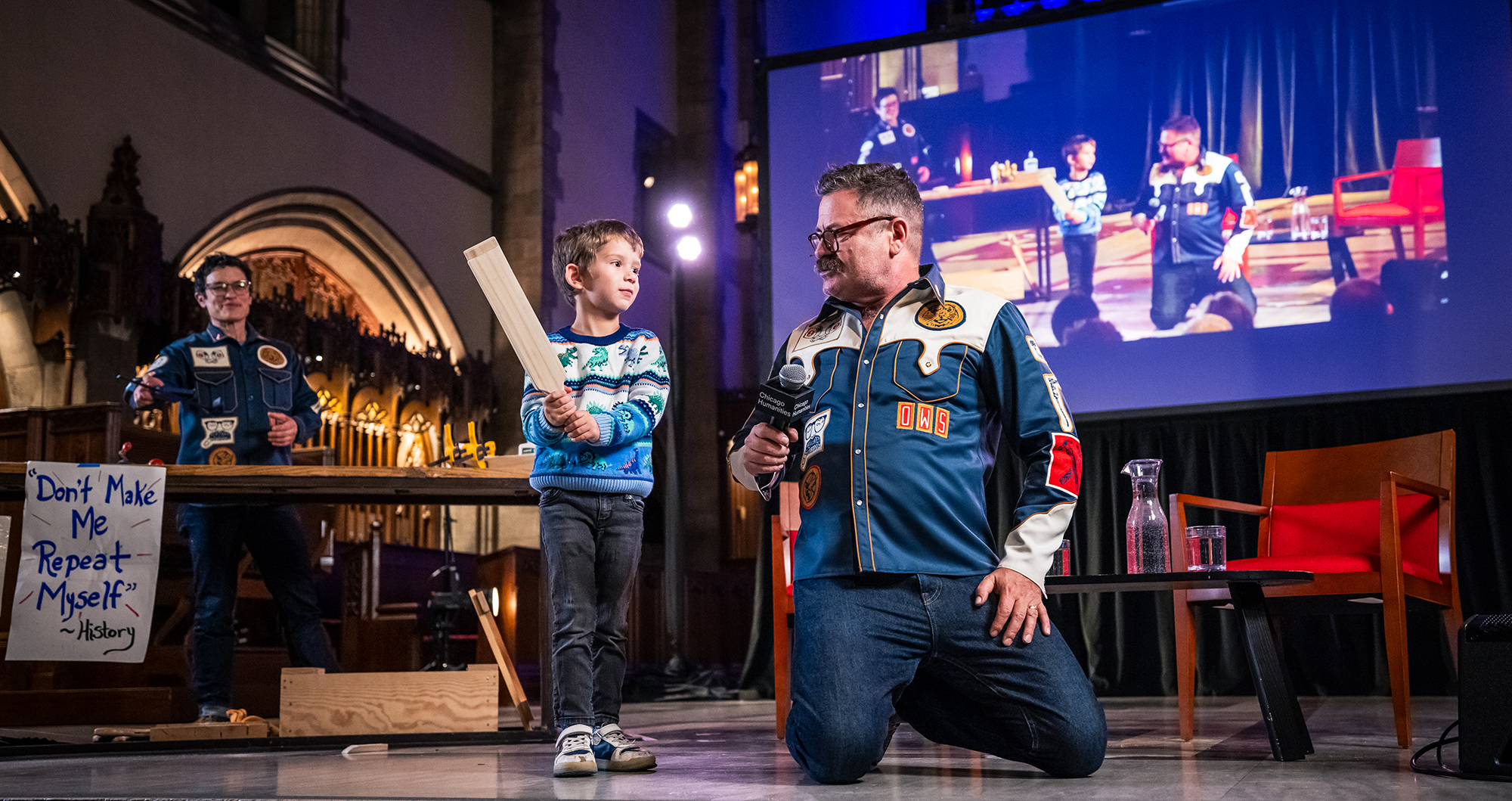
“Everyone has a gift from Mother Nature, what you’re good at. And you’re supposed to figure out how to use your gifts to be in service of others. So I don’t want a glam-dang robot getting to do my good work. I don’t want a company getting to steal my salvation and joy,” said Nick Offerman during a talk in Rockefeller Chapel about his new book, Little Woodchucks: Offerman Woodshop's Guide to Tools and Tomfoolery (Dutton, 2025). Above, a young audience member prepares to try out a slapstick made by Offerman’s coauthor, Lee Buchanan (left). (© David T. Kindler)
On UChicago Arts and Humanities Day 2025, the University threw open its doors to the city and to artists and thinkers of every stripe.
For 44 years UChicago’s Division of the Humanities set aside one Saturday each autumn to show off its intellectual and creative riches in an expansive set of talks and tours open to the public. In 2025 both Humanities Day and the division got updated names and broader ambitions to match. The latter became the Division of the Arts & Humanities, and it struck up a new partnership with the organization Chicago Humanities, itself recently transformed from the annual Chicago Humanities Festival into a year-round celebration of art, literature, performance, culture, and more. The Magazine was among the day’s more than 4,000 attendees, and brings you these dispatches.—L. D.
Garden View
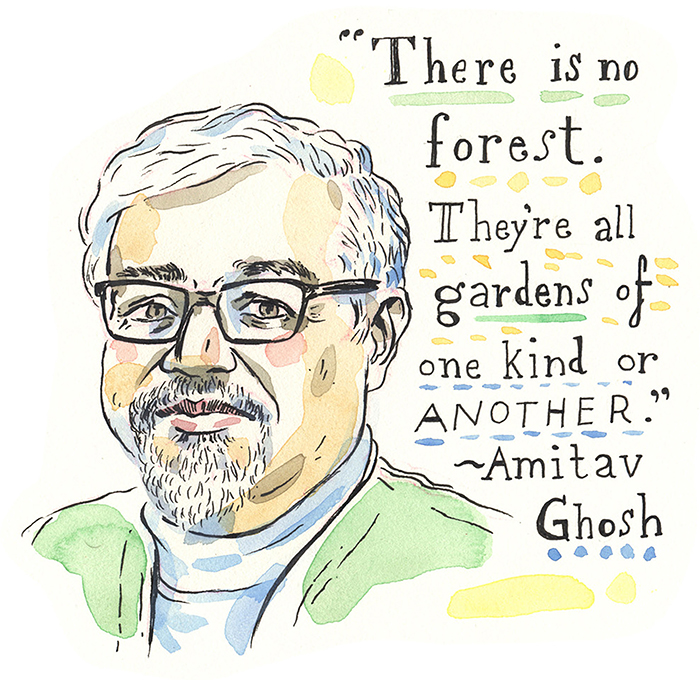
In conversation with UChicago associate professor of English Benjamin Morgan, Amitav Ghosh peppered his reflections on his prize-bedecked body of writing with contrarian thinking and the hard, bright currency of historical detail.
In more than 15 novels and essay collections, the Calcutta-born Ghosh has examined the fate of the natural world at the hands of colonial and capitalist incursion, and the fates of human beings living at the incursion sites. (Mentioned in Morgan and Ghosh’s conversation were West Bengal, Bangladesh, and the Amazon rainforest.) Those abiding concerns are also at the heart of Ghosh’s latest book, Wild Fictions: Essays on Literature, Empire, and the Environment (University of Chicago Press, 2025).
The book title’s wordplay connotes Ghosh’s conviction that, at least when taken to be distinct from the human world, “the wild” is a fiction, sometimes an instrumental one. He pointed to German forest policy in the 19th century, which he said reflected a view of forests as “a machine for creating timber”—a view that also influenced how the English treated India’s forests and how the United States has treated its own. But the Amazon rainforest, for example, “is supposed to have had a population of nine million people, so in fact, it’s not a forest,” Ghosh said. “It’s a garden. There is no forest. They’re all gardens of one kind or another. Humans are interacting with those forests.”
The midday event in Breasted Hall wasn’t Ghosh’s first UChicago rodeo. His 2016 nonfiction book, The Great Derangement: Climate Change and the Unthinkable (University of Chicago Press), began life as the 2015 Randy L. and Melvin R. Berlin Family Lectures at the University. In that series of talks and the resulting book, Ghosh explored why so little contemporary literary fiction had grappled with climate change, concluding that the scale of the crisis seemed too vast and improbable to effectively treat in the form of the novel.
Morgan asked Ghosh whether his perspective had changed in the succeeding 10 years, when climate change has become harder to overlook. “If I were writing that again,” Ghosh replied, “I wouldn’t focus so exclusively on climate change, because it’s not just climate change. As Margaret Atwood famously said, ‘It’s everything change.’” That is, biodiversity loss, species extinction, and other interlinked crises of the environment.
Ghosh also named notable omissions in his earlier indictment of fiction for turning a blind eye to climate change. Octavia E. Butler, Ursula K. Le Guin, and Doris Lessing (in her later works), he said, are some of the writers who have long dealt with it in their fiction—but their work has been marginalized by literary “gatekeepers” dismissive of science fiction and fantasy. Part of the problem, he now thinks, “is with the wider ecosystem of what we call literature.”—L. D.
The state of feminism
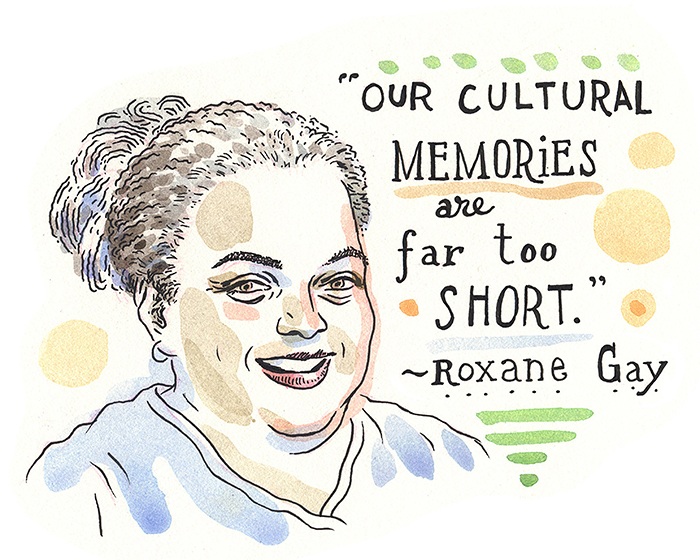
I wanted it to feel like a time capsule, like, look at how bad things were,” Roxane Gay said about her essay collection Bad Feminist (Harper Perennial, 2014). In the book, the writer, cultural critic, and Rutgers University professor explored a new idea of feminism that embraces contradictions. She reflected there on her own attempts to live as a feminist while enjoying pleasures seemingly at odds with the uncompromising feminist ideal she had learned—coming home to a caring partner, misogynistic music, the color pink.
But 11 years on, Gay told her interlocutor, Daisy Delogu, Howard L. Willett Professor of French Literature, it is bitter to consider the progress society has failed to achieve for women. “We’ve allowed this to happen,” she said, calling it “shameful,” and later reflected that “our cultural memories are far too short.” If she wrote the book today she would add a discussion of accountability mechanisms: “What do we do to get better?”
Gay’s reflections on the years since Bad Feminist included critiques of how women and race are being represented in media and pop culture. On the tradwife, a conservative avatar of femininity that has arisen in recent years: “As a feminist, I support your choice,” said Gay in a measured tone. But ultimately, “it is not empowering to choose to disempower yourself.” On the layered depiction of race and history in Ryan Coogler’s 2025 film Sinners: “Well done, Ryan. Gold star.”
There was a noticeable rustling as people hurried to scan the QR code projected onscreen to submit questions for Gay. Most asked for advice: An immigrant asked how they could take political action when they were afraid to go to protests (the suggestions: phone banking, sharing information with friends). Another attendee asked how we can pop the information bubbles people live in (Gay advised reminding people that facts do exist, and if a friend is watching Fox News, “snatch the remote and change that channel—to Lifetime”). Someone else asked how Gay finds peace (family and her Maltipoo, Max).
And what gives her hope? She took issue with the word—“hope is just deferring responsibility for creating change”—but she highlighted young people’s political engagement. “The way forward,” she said, “has to be cross-generational.”—C. C.
How Free Is Campus Speech?
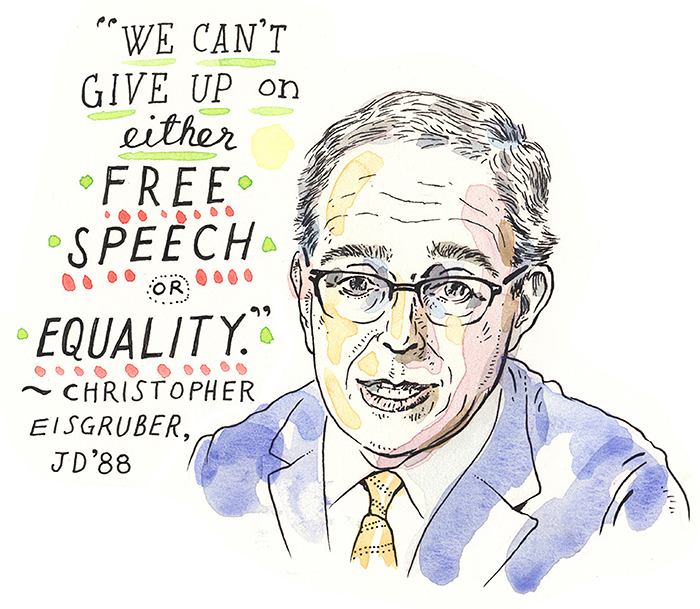
Saturday morning in the Max Palevsky Cinema, Law School professor Tom Ginsburg sat down with Law School alumnus and president of Princeton Christopher Eisgruber, JD’88, to talk about something on a lot of college and university leaders’ minds right now: free speech.
Both came to the discussion with bona fides. Ginsburg, the Leo Spitz Distinguished Service Professor of International Law, is the inaugural faculty director of the University of Chicago Forum for Free Inquiry and Expression, launched in 2023. Eisgruber, Princeton’s president since 2013, had just published Terms of Respect: How Colleges Get Free Speech Right (Basic Books, 2025) in September.
Ginsburg began by floating a micro summary of the book: “The kids are all right.” In other words, Eisgruber seemed to him to be saying that despite how much higher education gets lambasted for unfree expression and other failings, universities are “actually getting a lot of things right.”
Eisgruber agreed but added context: “What I say in the book is that we are committed as a country and on college campuses to promote both free speech and equality, and to promote them together in a way that contributes to civil discussions. … That is a very demanding set of ideals, but we can’t give up on either free speech or equality.” Under the circumstances of extreme political polarization exacerbated by social media, promoting both is a hard challenge. In his eyes, higher education institutions are “getting it much more right than they get credit for.”
Yes, Eisgruber acknowledged, students and faculty say things that are inadvisable. But college campuses are supposed to be “places where students are learning and making mistakes.” Such places require “extraordinary freedom and intellectual speculation, … and that means sometimes things are going to go wrong.”
Social media posts about “a professor who has said an outlandish thing or a student who has done something silly” get thousands of clicks. Less conspicuously, “we’ve got 2,500 colleges or universities in the country and millions of conversations, events, lectures going on at those places, most of which end up going very well.”
That said, the challenges persist and they’re intrinsically not easy. “We’ve got to protect disrespectful speech. We’ve got to protect even hateful speech. That’s important,” Eisgruber said. “But at the same time, we have to build a community where people are respecting one another.”
Later the two addressed institutional speech, about which UChicago and Princeton take differing views. Ginsburg reminded the audience of UChicago’s 1967 Kalven Report on the much-discussed principle of institutional neutrality, whereby universities refrain from taking positions on most issues of the day in deference to students’ and faculty’s freedom to have their say. Princeton, Ginsburg said, “has taken an alternative formulation,” which Eisgruber calls institutional restraint.
Eisgruber said that he finds a lot to like in the Kalven Report but has reservations too. Some of the good: “It is saying universities are going to be highly upsetting institutions.” Less so: the idea that this “is a good reason for me and other university presidents to refrain from taking political stands.” To him, the report seems here to duck, since such position taking will “attract all sorts of incoming fire, and we’ve got enough incoming fire already, right?”
But universities are not neutral, Eisgruber said, quoting a predecessor, former Princeton president William G. Bowen: “‘Universities are value-laden institutions, and my job as a university president is to speak up for those values.’”
That, Ginsburg countered, speaks to the exception made in the Kalven Report for occasions when the University and its mission of free inquiry are under threat. “And I don’t think there’s any doubt that we are in such a moment.”—L. D.
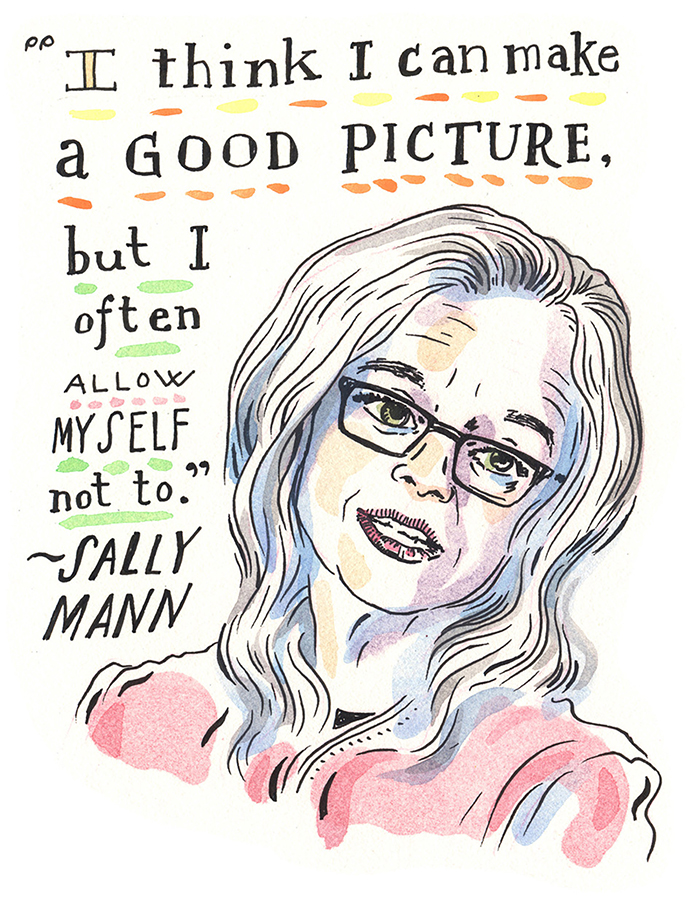
Photo realism
“How do you know good art, and then what is art good for?” Laura Letinsky, a photographer and professor in the Department of Visual Arts, challenged Sally Mann. The renowned photographer and writer is best known for her black-and-white images of her children, sometimes pictured nude, on and around the family’s Appalachian property. “Your gut will tell you what’s a good picture,” Mann responded. As for the second part of the question: “Roiling your gut, maybe.”
The feeling that a picture you’re making is real art is “a minor form of ecstasy,” added Mann. Letinsky agreed, saying she struggles to find the words to describe the sensation—for her it mostly involves a lot of expletives. Mann found the words, and poetic ones at that, describing the awareness that she’s about to take a great photograph as coming from “a little tuning fork in my viscera.”
This instinctive recognition of art is different from artistic talent, though, which Mann said she doesn’t really believe in. If there’s no such thing, Letinsky wanted to know, then “can art be taught?” Mann described becoming an artist as a gradual stripping away. Just as one tries and moves away from different kinds of jobs, so too a budding artist will study the work of others and try different styles. “As you discard things, what you do want to do becomes clear”—and it’s essential for artists to master a technique before they can break from it. “I think I can make a good picture,” she said, “but I often allow myself not to.”
With respect to her tools, Mann had a big reveal. She has begun using a digital camera—and photographing in color. The audience and Letinsky gasped. All leaned in to hear about the new camera and the vintage screw-on lens that Mann said “can’t take a bad picture,” the lens adding mystery to the already “mystical” light in the Mississippi Delta, where she’s been working recently.
Aside from giving you a feeling in the pit of your stomach, Mann was sure that the purpose of good art is to challenge you and make you think. She’s faced the consequences of such provocation—her pictures of her children were caught up in culture wars in the 1990s and again today. Despite the controversy, she has stuck to her vision: Art is good if it digs into difficult topics and “makes your gut sing, in the nicest way.”—C. C.
Out in the Open
Saturday evening in Mandel Hall, Harvard psychologist Steven Pinker was in conversation with Jason Bridges, associate professor of philosophy at UChicago, about Pinker’s 12th and latest book, When Everyone Knows That Everyone Knows … Common Knowledge and the Mysteries of Money, Power, and Everyday Life (Scribner, 2025). They began by distinguishing the book’s sense of “common knowledge” from the term’s everyday meaning: things that are widely known.
The kind of common knowledge examined in the book is more reciprocal. “In the technical sense, from philosophy, game theory, and economics,” Pinker said, common knowledge refers to “something that is known to be known.” In other words, “I know something, you know it. I know that you know it. You know that I know it. I know that you know that I know it.” And so on, sometimes mind-bendingly far.
A handy example, he said, is the story of the emperor’s new clothes. Everyone in the story presumably knows the emperor has no clothes on, but when the child says it out loud, everything changes. As an example of common knowledge from everyday life, he offered the signing of contracts, where “part of that very event is that it’s being perceived by everyone.”
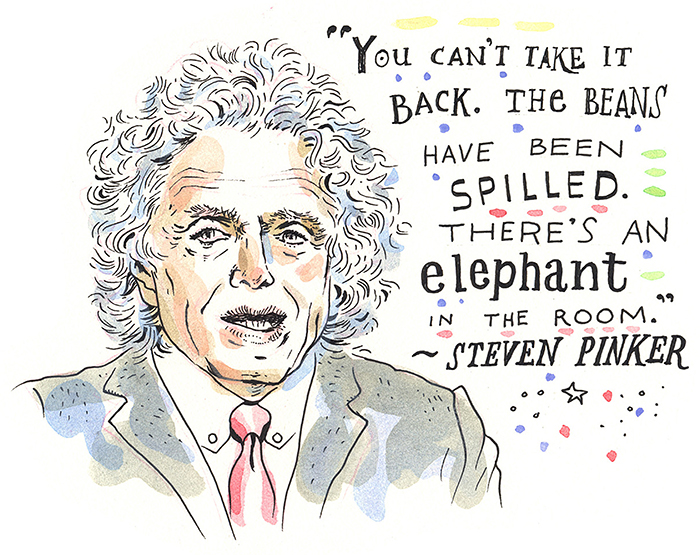
After knowledge has become so public, “you can’t take it back,” Pinker elaborated. “The beans have been spilled. There’s an elephant in the room.” For Pinker this kind of common knowledge—he also called it “joint attention” and “triangular awareness”—forms the basis for our social relationships, which depend on coordination.
And it may shed light on certain mysteries of human behavior. Although language is the primary way we establish common knowledge, we also use facial expressions, eye contact, and even involuntary body language like blushing and crying to signal what we know and to understand what others know. “Why did, presumably, evolution see fit to add a signaling system as weird as our eyes overflowing with tears,” Pinker asked, “something that is not found, apparently, in any other organism?”
His surmise: to make important emotions plain to see. “It’s mysteries like that that I invoke the notion of common knowledge to explain,” he said. “Namely, there are some signals that have to be perceived from both the inside and the outside, together with the knowledge that they are being perceived by the other party.”—L. D.
Get Your Freakonomics On
Last year marked the 20th anniversary of Freakonomics: A Rogue Economist Explores the Hidden Side of Everything (William Morrow, 2005) by UChicago economist Steven Levitt, William B. Ogden Distinguished Service Professor Emeritus, and Stephen J. Dubner. Deborah L. Nelson, dean of the Division of the Arts & Humanities and Helen B. and Frank L. Sulzberger Professor of English, sat down with Dubner for a freewheeling chat about the runaway bestseller. The following excerpts have been edited and condensed.
Nelson If you’re celebrating a 20th anniversary, you must tell an origin story.
Dubner I’d left The New York Times and I was on my own, a freelancer, essentially, and I had a couple other books under contract. I was probably a chapter or two into writing one when my editor at The New York Times Magazine, where I used to work, said, “There’s this guy at the University of Chicago named Steve Levitt who just won this award called the John Bates Clark Medal.”
Do you all know what the Clark Medal is? The econ people know. It’s a big, big, big deal. It used to be called the Junior Nobel. I actually turned down the assignment like two or three times because I was already working on a book.
Then I happened to be in Chicago for something else, and I decided, let me look at Levitt’s papers. I downloaded them all and started to read them—like, oh my god, he’s just so weird and interesting.
As I was reading them, my first thought was oh, he’s doing in economics what I want to be doing as a writer, which is finding areas that are less trod than normal and going deep on them. So anyway, I came out here. He tells a story that I promised I’d only be here for two hours, and I stayed for three days. I think that’s slightly exaggerated. I probably told him four hours and it was four days. But anyway, I just loved his brain.
Nelson I have to notice that you’re a musician and a writer and an editor, and you’re doing none of that without the kind of work we teach in the Arts & Humanities Division. That tool that Stephen Levitt built is still useless unless you have a way to use a story to explain what it does and how it works.
Dubner Levitt said this to me when I first met him. He said that economics is a science with a bunch of great tools to answer difficult, challenging, unusual questions—but a paucity of good questions. And Levitt came up with very, very interesting questions and then used the tools of economics, that are typically applied to much more normal things like unemployment and the market, and applied them to small, weird micro environments.
Nelson So how do you know what an unusual question is?
Dubner For me, the secret is just curiosity. I’m just this dime-store curious person, like a child. I’m basically a child. And, you know, all children are scientists. If I drop this, what happens? Oh, it breaks. Then I get yelled at. So I just learned two things there, gravity and punishment-reward.
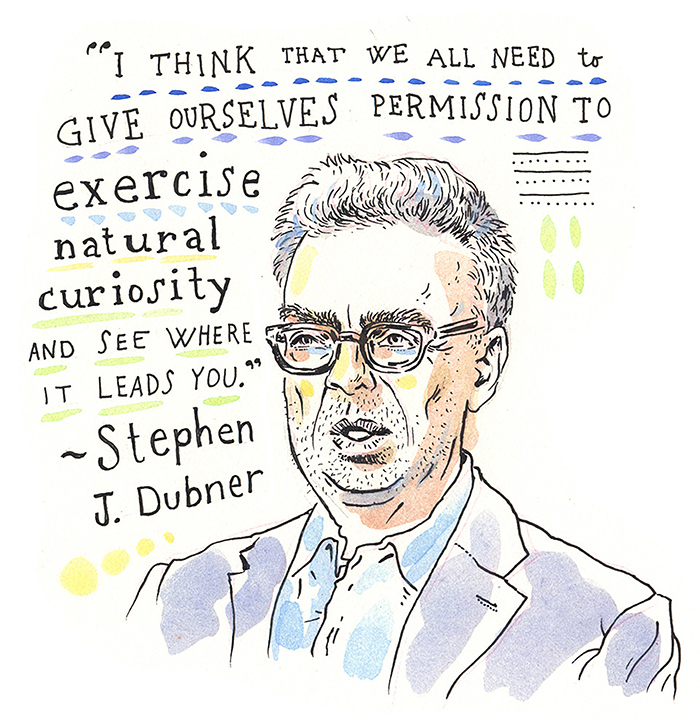
I think that we all need to give ourselves permission to exercise natural curiosity and see where it leads you. It will lead you to places that everybody else isn’t already thinking about.
Campus tour: Care of Theaster Gates
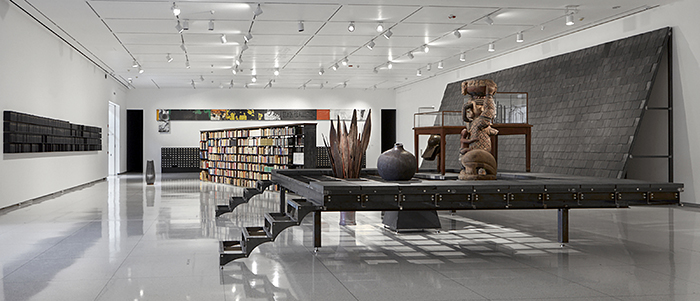
The internationally known artist and professor of visual arts Theaster Gates has described himself as a “keeper of objects.” The Smart Museum of Art exhibition Theaster Gates: Unto Thee, Gates’s first major solo show in his hometown, highlights objects he has collected from the University of Chicago and other sources. On Arts and Humanities Day cocurators Vanja Malloy, the Dana Feitler Director of the Smart Museum of Art, and Galina Mardilovich led about 20 arts enthusiasts on a tour of the campus buildings from which Gates’s materials were sourced.
Glass lantern slides
The first objects didn’t have far to travel: It’s a collection of 72,000 glass lantern slides from the Department of Art History in the Cochrane-Woods Art Center, across a courtyard from the Smart Museum, where the tour began. Malloy and Mardilovich explained that the slides were previously used in art history classes starting from the department’s founding in 1902. The heavy glass slides were the first objects Gates acquired from the University, in the late 2000s, and he had to reinforce the floor of the building that would house them. (The Smart Museum also consulted with a structural engineer when preparing to exhibit them, said Mardilovich.) In Unto Thee, low black filing cabinets holding the slides span the wall behind which the Gates’s film Art Histories: A Reprise plays, with images of the slides appearing in the film.
Bond Chapel pews
From the Smart Museum, the tour headed to Bond Chapel. When the chapel’s original oak pews were removed to make way for more versatile and accessible seating, they came into Gates’s care. The pews—the only piece in Unto Thee that visitors can physically interact with—sit in the darkened room where Art Histories plays, a setup that emphasizes the gospel and chant elements used by the Black Monks, Gates’s musical ensemble, which is featured in the film.
ISAC vitrines
Outside the Institute for the Study of Ancient Cultures, the cocurators explained that when the institute was modernized in 2019 for its 100-year anniversary, the museum staff replaced display cases from the 1930s with more modern vitrines. Gates was offered some of the old cases.
Two of the vitrines appear in Unto Thee. One, with a piece of masking tape labeled “FOYER” on its side, contains a jumble of the thin metal mounts that used to hold artifacts; typically out of sight, the mounts here become art objects in themselves. Gates removed the bottom of the second case and placed a masklike African object underneath it, its horns peeking up inside the glass.
Rockefeller Chapel slate roof tiles
The carillon bells were ringing as the tour approached Rockefeller Chapel. The scaffolding that covered one side of the building for months had been removed, and the copper trim shone brightly around a sloped roof on the northeast side. Approximately 9,000 slate roof tiles, removed in the late 2000s during a restoration project, were eventually given to Gates. The tiles form a roof again in Unto Thee, displayed alongside other pieces made with roofing materials. Gates returns to roofs again and again in his work, in honor of his father’s occupation as a roofer.
Lorado Taft Midway Studios concrete floor
The tour crossed the Midway for its next two stops. Lorado Taft Midway Studios was an independent art studio that became the University’s fine arts studio in the 1940s and served as the workplace for artists, including one of Gates’s mentors, the ceramic sculptor Ruth Duckworth. When the building was renovated in the 2010s, Gates felt guilty that Duckworth’s kiln was removed, but he was able to preserve pieces of the concrete flooring that originally stood under it. Bearing stains of paint and other materials from years of use, four slabs of this concrete now support a ceramic figure of Gates’s as part of Unto Thee.
Logan Center granite tiles
En route to the Reva and David Logan Center for the Arts, the tour walked across large rectangular black granite tiles. Gates was involved in the planning of the arts center, completed in 2012, the same year he joined the UChicago faculty. He acquired tiles left over from the construction project. In Unto Thee they are part of African Still Life #4, paving the raised platform that holds the ISAC vitrines, three African objects, and one of several of Gates’s own wood-fired ceramic sculptures.—C. C.
Read more about Arts and Humanities Day 2025 at UChicago News.